
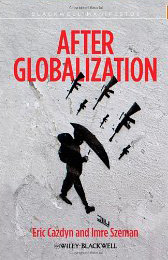
 – After Globalization by Eric Cazdyn and Imre Szeman
In lively and unflinching prose, Eric Cazdyn and Imre Szeman argue that contemporary thought about the world is disabled by a fatal flaw: the inability to think “an after” to globalization. After establishing seven theses (on education, morality, history, future, capitalism, nation, and common sense) that challenge the false promises that sustain this time-limit, After Globalization examines four popular thinkers (Thomas Friedman, Richard Florida, Paul Krugman and Naomi Klein) and how their work is dulled by these promises. Cazdyn and Szeman then speak to students from around the globe who are both unconvinced and uninterested in these promises and who understand the world very differently than the way it is popularly represented. After Globalization argues that a true capacity to think an after to globalization is the very beginning of politics today.
-The Flash of Capital: Film and Geopolitics in Japan by Eric Cazdyn
In Japan, perhaps uniquely, the history of capitalism coincides neatly with the history of film. What links these two histories and what their relationship reveals about film culture and everyday life in Japan, is the subject of this original and provocative work. Looking at a hundred-year history of film and capitalism, The Flash of Capital theorizes a cultural history that illuminates the spaces where film and the nation transcend their customary borders, where culture and capital crisscross-and in doing so, develops a new way of understanding historical change and transformation in modern Japan and beyond. Eric Cazdyn focuses on three key moments of historical contradiction: colonialism, post-war reconstruction, and globalization. In great classics of Japanese film, in documentaries, works of science fiction, animation, and pornography he brings to light cinematic attempts to come to terms with the tensions inherent in each historical moment-tensions between colonizer and colonized, between the individual and the collective, and between the national and the transnational. Through a close reading of cinema within its political context, Cazdyn shows how formal inventions in the realms of acting, film history and theory, thematics, documentary filmmaking, and adaptation articulate a struggle to solve implacable historical problems. Richly illustrated, this innovative work of cultural history and criticism will be of interest to those concerned with Japanese film history, the culture and political economy of Japan, and anyone seeking explanations of historical change that challenge conventional distinctions between the aesthetic and the geopolitical.
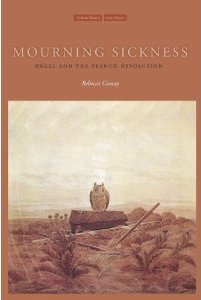 -Mourning Sickness: Hegel and the French Revolution
This book explores Hegel’s response to the French Revolutionary Terror and its impact on Germany. Like many of his contemporaries, Hegel was struck by the seeming parallel between the political upheaval in France and the upheaval in German philosophy inaugurated by the Protestant Reformation and brought to a climax by German Idealism. Many thinkers reasoned that a political revolution would be unnecessary in Germany, because this intellectual “revolution” had preempted it. Having already been through its own cataclysm, Germany would be able to extract the energy of the Revolution and channel its radicalism into thought. Hegel comes close to making such an argument too. But he also offers a powerful analysis of how this kind of secondhand history gets generated in the first place, and shows what is stake. This is what makes him uniquely interesting among his contemporaries: he demonstrates how a fantasy can be simultaneously deconstructed and enjoyed.
Mourning Sickness provides a new reading of Hegel in the light of contemporary theories of historical trauma. It explores the ways in which major historical events are experienced vicariously, and the fantasies we use to make sense of them. Comay brings Hegel into relation with the most burning contemporary discussions around catastrophe, witness, memory, and the role of culture in shaping political experience.
 – Christopher Okigbo: Christopher Okigbo (1932-1967) by Uzoma Esonwanne and by Hazard Adams
Barbara Havercroft
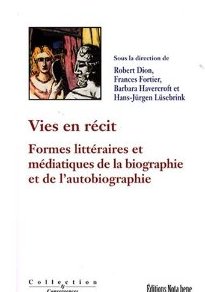 VIES EN RÉCITS : FORMES LITTÉRAIRES ET MÉDIATIQUES DE LA BIOGRAPHIE ET DE L’AUTOBIOGRAPHIE
Depuis plus de 30 ans, des centaines de livres et des milliers d’articles sur la biographie et l’autobiographie ont vu le jour dans de nombreux pays, accompagnés d’un nombre considérable de textes dits ” personnels ” ainsi que d’autres types de manifestations relevant de l’auto/biographique qui se retrouvent tant au cinéma que sur les pages virtuelles d’Internet.
Loin de se cantonner à la seule sphère universitaire, cet engouement semble caractériser toute la culture occidentale contemporaine, où prolifèrent récits de soi, témoignages oraux, écrits et visuels, blogs et pages personnelles sur le web, émissions de téléréalité, et ainsi de suite. Si le statut du sujet de l’auto/biographie reste peu problématisé dans les réalisations visant le grand public, il en va autrement dans des oeuvres significatives récentes, qu’elles soient littéraires ou cinématographiques.
On y assiste bel et bien au retour du sujet, mais pas naïvement, car en tant que construction discursive et horizon fuyant il n’est doté ni de contours solides, ni de certitude métaphysique. Et ce sujet vacillant semble aujourd’hui s’inscrire dans des pratiques auto/biographiques on ne peut plus hétérogènes, hétérodoxes, qui se démarquent des configurations canoniques des sous-genres personnels. Les textes rassemblés ici s’intéressent à ces modes hétérodoxes de mise en récit de la vie privée, qu’il s’agisse de la sienne propre ou de celle d’un autre.
Multipliant les exemples puisés aussi bien dans la littérature que dans l’historiographie et dans les médias contemporains, ils entendent se situer au plus près des nouvelles pratiques de l’écriture biographique et autobiographique.
Le Roman Français de l’Extrême Contemporain
Peut-on encore parler du roman français au singulier aujourd’hui ? Une recherche attentive sur les esthétiques principales ou singulières du roman dit de l’extrême contemporain permet de constater qu’aucune école ou aucun groupe ne domine l’univers romanesque, et qu’aucun mouvement n’impose profondément sa marque sur la scène littéraire. Cela ne signifie pas pour autant qu’il ne reste que des oeuvres disparates et qu’il soit impossible d’organiser une cohérence en arrêtant des corpus. Dans de tels cas, c’est moins chercher du côté de certaines pratiques transversales. Dans cet ouvrage collectif, le point de départ ne consiste pas à se demander si le roman conserve une pertinence en tant que témoin privilégié de la littérature aujourd’hui – cela semble relever de l’évidence -, mais plutôt à identifier ce qui lui confère cette légitimité. Cet ouvrage vise aussi à appréhender la notion de contemporanité à partir de la littérature, du roman. Plus globalement, sans tenter d’offrir un vaste panorama du roman français d’aujourd’hui, son objectif consiste à mieux saisir la pertinence du roman grâce à un ensemble d’études conçues à partir d’axes précis (les idées, le réel, le jeu, le soi) sur les possibles du roman, qu’il adopte une forme fragmentée ou théâtralisée, qu’il préconise un savant collage ou un métadiscours narrativisé, qu’il puise abondamment dans l’autobiographie ou l’essai. Le postulat au fondement de cet ouvraghe défend l’idée qu’il existe des romans français importants ou singuliers à notre époque et que nous devons les découvrir et mieux les comprendre. Avec des textes de René Audet, Yves Baudelle, Bruno Blanckeman, Florance de Chalonge, Jean-Michel Devésa, Robert Dion, Catherine Douzou, Valérie Dusaillant-Fernandes, Frances Fortier, Bertrand Gervais, Barbara Havercroft, Liesbeth Korthals Altes, Andrée Mercier, Pascal Michelucci, Warren Motte, Élisabeth Nardout-Lafarge, Joëlle Papillon, Pascal Riendau, Catherine Rodgers, Gianfranco Rubino, Gill Rye, Ralph Sarkonak et Dominique Viart
Eva-Lynn Jagoe
– The End of the World as They Knew It: Writing Experiences of the Argentine South
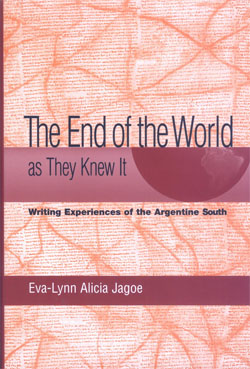 The End of the World as They Knew It maps the shifting constructions of the space of the South in Argentine discourses of identity, nation, and self-fashioning. In works by Domingo F. Sarmiento, Lucio V. Mansilla, Francisco P. Moreno, Jorge Luis Borges, Ricardo Piglia, and César Aira, Eva-Lynn Alicia Jagoe examines how representations of the South – as primitive, empty, violent, or a place of potential – inform Argentine liberal ideology. Part of this process entails the reception of travel narratives by Francis Bond Head, Charles Darwin, and W.H. Hudson, which served the purpose of ratifying the gaze of the crioloo , and of appropriating the South through civilized discourses. Focusing on crucial moments in Argentine cultural history, such as the 1871 Conquest of the Desert and the military dictatorship of the 1970s, Jagoe compellingly argues that these intensely experiential narrations of the South are inextricably linked to questions of collective memory and the construction of an Argentine history and tradition.
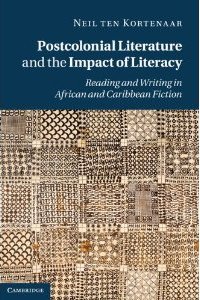 – Postcolonial Literature & the Impact of Literacy: Reading and Writing in African and Caribbean Fiction
Examining images of literacy in African and West Indian novels, Neil ten Kortenaar looks at how postcolonial authors have thought about the act of writing itself. Writing arrived in many parts of Africa as part of colonization in the twentieth century, and with it a whole world of book-learning and paper-pushing; of school and bureaucracy; newspapers, textbooks and letters; candles, hurricane lamps and electricity; pens, paper, typewriters and printed type; and orthography developed for formerly oral languages. Writing only penetrated many layers of West Indian society in the same era. The range of writers is wide, and includes Chinua Achebe, Wole Soyinka and V. S. Naipaul. The chapters rely on close reading of canonical novels, but discuss general themes and trends in African and Caribbean literature. Ten Kortenaar’s sensitive and penetrating treatment of these themes makes this an important contribution to the growing field of postcolonial literary studies.
 -Self, Nation, Text in Salman Rushdie’s “Midnight’s Children”
Many non-Indian readers find the historical and cultural references in Salman Rushdie’s “Midnight’s Children” demanding. In his close reading of the novel, Neil ten Kortenaar offers post-colonial literary strategies for understanding “Midnight’s Children” that also challenge some of the prevailing interpretations of the novel. Using hybridity, mimicry, national allegory, and cosmopolitanism, all key critical concepts of postcolonial theory, ten Kortenaar reads “Midnight’s Children” as an allegory of history, as a Bildungsroman and psychological study of a burgeoning national consciousness, and as a representation of the nation. He shows that the hybridity of Rushdie’s fictional India is not created by different elements forming a whole but by the relationship among them.”Self, Nation, Text in Salman Rushdie’s Midnight’s Children” also makes an original argument about how nation-states are imagined and how national consciousness is formed in the citizen. The protagonist, Saleem Sinai, heroically identifies himself with the state, but this identification is beaten out of him until, in the end, he sees himself as the Common Man at the mercy of the state. Ten Kortenaar reveals Rushdie’s India to be more self-conscious than many communal identities based on language: it is an India haunted by a dark twin called Pakistan; a nation in the way England is a nation but imagined against England. Mistrusting the openness of Tagore’s Hindu India, it is both cosmopolitan and a specific subjective location.
 -Socialist Realism without Shores
“Socialist Realism without Shores” offers an international perspective on the aesthetics of socialist realism – an aesthetic that, contrary to expectations, survived the death of its originators and the demise of its original domain. This expanded edition of a special issue of the “South Atlantic Quarterly” brings together scholars from various parts of the globe to discuss socialist realism as it appears across genres in art, architecture, film, and literature and across geographic divides – from the ‘centre,’ Russia, to various points at the ‘periphery’ – China, Germany, France, Poland, remote republics of the former USSR, and the United States.The contributors argue that socialist realism has never been a monolithic art form and demonstrate, among other things, that its literature could accommodate psychoanalytic criticism; that its art and architecture could affect the aesthetic dictates of Moscow that made ‘Soviet’ art paradoxically heterogeneous; and that its aesthetics could accommodate both high art and crafted kitsch. “Socialist Realism without Shores” also addresses the critical discourse provoked by socialist realism – Stalinist aesthetics, ‘anthropological’ readings; ideology critique and censorship; and the sublimely ironic approaches adapted from sots art, the Soviet version of postmodernism. The contributors include: Antoine Baudin, Svetlana Boym, Greg Castillo, Katerina Clark, Evgeny Dobrenko, Boris Groys, Hans Gunther, Julia Hell, Leonid Heller, Mikhail Iampolski, Thomas Lahusen, Regine Robin, Yuri Slezkine, Lily Wiatrowski Phillips, Xudong Zhang, and Sergei Zimovets.
– How Life Writes the Book: Real Socialism and Socialist Realism in Stalin’s Russia
“A gripping, unsettling, and highly original book that turns the making of a Soviet socialist-realist classic–Azhaev’s Far from Moscow–into a detective story, and sheds as strange and ambiguous a light on the Stalin era, from gulag to Writers’ Union, as one could hope for. Lahusen is a disarmingly low-key scholarly virtuoso who performs simultaneously as an archive-based historian, an interpreter of texts (including Azhaev’s own self-organized archive), and a gently relentless biographer whose stalking of his prey is reminiscent of Nabokov. The final chilling paragraph typically economical and understated, is a reminder that the author/investigator, too, is a collaborator in the multiple reworkings of Azhaev’s text, and of his life, that How Life Writes the Book has so finely analyzed.”–Sheila Fitzpatrick, University of Chicago.
Late Soviet Culture from Perestroika to Novostroika
As the Soviet Union dissolved, so did the visions of past and future that informed Soviet culture. With Dystopia left behind and Utopia forsaken, where do the writers, artists, and critics who once inhabited them stand? In an “advancing present,” answers editor Thomas Lahusen. Just what that present might be–in literature and film, criticism and theory, philosophy and psychoanalysis, and in the politics that somehow speaks to all of these—is the subject of this collection of essays.
Leading scholars from the former Soviet Union and the West gather here to consider the fate of the people and institutions that constituted Soviet culture. Whether the speculative glance goes back (to czarist Russia or Soviet Freudianism, to the history of aesthetics or the sociology of cinema in the 1930s) or forward (to the “market Stalinism” one writer predicts or the “open text of history” another advocates), a sense of immediacy, or history-in-the-making animates this volume. Will social and cultural institutions now develop organically, the authors ask, or is the society faced with the prospect of even more radical reforms? Does the present rupture mark the real moment of Russia’s encounter with modernity? The options explored by literary historians, film scholars, novelists, and political scientists make this book a heady tour of cultural possibilities. An expanded version of a special issue of South Atlantic Quarterly (Spring 1991), with seven new essays, Late Soviet Culture will stimulate scholar and general reader alike.
Contributors. Katerina Clark, Paul Debreczeny, Evgeny Dobrenko, Mikhail Epstein, Renata Galtseva, Helena Goscilo, Michael Holquist, Boris Kagarlitsky, Mikhail Kuraev, Thomas Lahusen, Valery Leibin, Sidney Monas, Valery Podoroga, Donald Raleigh, Irina Rodnyanskaya, Maya Turovskaya
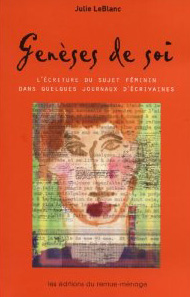
-Genèses de soi
Combinant les apports de la génétique textuelle et les théories de l’écriture au féminin, Julie LeBlanc consacre cet essai à la genèse de certaines œuvres de Marie-Claire Blais, Nicole Brossard, Annie Ernaux, Madeleine Monette et Madeleine Ouellette-Michalska. Pour réaliser ce travail, elle a pu consulter les archives de ces écrivaines, qui ont donné accès à des manuscrits et à des journaux d’écriture, des documents pour la plupart inédits. Première partie : La genèse d’un journal 1. Autotextes, avant-textes, intertextes : le journal diffusé de Madeleine Ouellette-Michalska comme avant-texte du journal publié 2. Écriture et réécriture au féminin : les journaux de Nicole Brossard Deuxième partie : Le journal d’une genèse 3. Les carnets d’écriture de Marie-Claire Blais 4. Le journal d’écriture comme laboratoire de l’œuvre : Passion simple et Se perdre d’Annie Ernaux. Troisième partie : le roman-journal, simulation d’une écriture autobiographique au féminin 5. Le statut du référent dans les récits autobiographiques : œuvres de fiction et de non-fiction 6. De la réalité autobiographique à la fiction de l’imaginé :Le double suspect de Madeleine Monette.
– Enonciation et inscription du sujet 
Ce travail s’inscrit au coeur même de la recherche de pointe sur la subjectivité et ses avatars textuels. En tant que tel, il constitue un apport téel à nos connaissances car il élabore une méthodologie qui constitue le lieu de rencontre de la théorie de l’énonciation et des sciences humaines : sa fonction reste celle d’établir un rapport entre le savoir épistémologique et le savoir textuel, il nous présente tout d’abord un balissage raisonné, historico-notionnel des théories les plus marquantes et les plus actuelles sur l’énonciation, La valeur heuristique d’une telle approche s’apprécie tout particulièrement dans les deuxième et troisième parties de cette étude portant sur les textes et les avant=textes romanesques de Gilbert La Rocque. Ce dispositif analytique d’une grande finesse et d’une rigueur évidentes permet de construire des nivaux de signification, voire de sens, jusqu’ici insoupçonnés ou mal exploités dans les romans et manuscrits de Gilbert La Rocque.” Paul Perron, msrc Université de Toronto.
Roland Le Huenen
-Balzac – Semiotique Du Personnage Romanesque-l’exemple D’eugenie Grandet by Roland Le Huenen
-Paratextes Balzaciens: La Comedie Humaine En Ses Marges by Roland Le Huenen
 -The Neo-Primitivist Turn: Critical Reflections on Alterity, Culture, and Modernity
In recent years the concept of ‘the primitive’ has been the subject of strong criticism; it has been examined, unpacked, and shown to signify little more than a construction or projection necessary for establishing the modernity of the West. The term ‘primitive’ continues, however, to appear in contemporary critical and cultural discourse, begging the question: Why does primitivism keep reappearing even after it has been uncovered as a modern myth?
In The Neo-primitivist Turn, Victor Li argues that this contentious term was never completely banished and that it has in fact reappeared under new theoretical guises. An idealized conception of ‘the primitive,’ he contends, has come to function as the ultimate sign of alterity. Li focuses on the works of theorists like Jean Baudrillard, Jean-François Lyotard, Marianna Torgovnick, Marshall Sahlins, and Jürgen Habermas in order to demonstrate that primitivism continues to be a powerful presence even in those works normally regarded as critical of the concept. Providing close readings of the ways in which the premodern or primitive is strategically deployed in contemporary critical writings, Li’s interdisciplinary study is a timely and forceful intervention into current debates on the politics and ethics of otherness, the problems of cultural relativism, and the vicissitudes of modernity.
Mary Nyquist
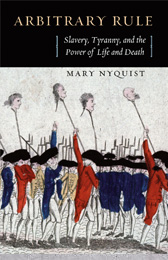
ARBITRARY RULE
Slavery, Tyranny, and the Power of Life and Death
Arbitrary Rule is the first book to tackle political slavery’s discursive complexity, engaging Eurocolonialism, political philosophy, and literary studies, areas of study too often kept apart. Nyquist proceeds through analyses not only of texts that are canonical in political thought—by Aristotle, Cicero, Hobbes, and Locke—but also of literary works by Euripides, Buchanan, Vondel, Montaigne, and Milton, together with a variety of colonialist and political writings, with special emphasis on tracts written during the English revolution. She illustrates how “antityranny discourse,” which originated in democratic Athens, was adopted by republican Rome, and revived in early modern Western Europe, provided members of a “free” community with a means of protesting a threatened reduction of privileges or of consolidating a collective, political identity. Its semantic complexity, however, also enabled it to legitimize racialized enslavement and imperial expansion. Throughout, Nyquist demonstrates how principles relating to political slavery and tyranny are bound up with a Roman jurisprudential doctrine that sanctions the power of life and death held by the slaveholder over slaves and, by extension, the state, its representatives, or its laws over its citizenry.
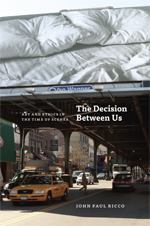
The Decision Between Us
The Decision Between Us combines an inventive reading of Jean‐Luc Nancy with queer theoretical concerns to argue that while scenes of intimacy are spaces of sharing, they are also spaces of separation. John Paul Ricco shows that this tension informs our efforts to coexist ethically and politically, an experience of sharing and separation that informs any decision. Using this incongruous relation of intimate separation, Ricco goes on to propose that “decision” is as much an aesthetic as it is an ethical construct, and one that is always defined in terms of our relations to loss, absence, departure, and death.
Laying out this theory of “unbecoming community” in modern and contemporary art, literature, and philosophy, and calling our attention to such things as blank sheets of paper, images of unmade beds, and the spaces around bodies, The Decision Between Us opens in 1953, when Robert Rauschenberg famously erased a drawing by Willem de Kooning, and Roland Barthes published Writing Degree Zero, then moves to 1980 and the “neutral mourning” of Barthes’ Camera Lucida,
and ends in the early 1990s with installations by Felix Gonzalez‐Torres. Offering surprising new considerations of these and other seminal works of art and theory by Jean Genet, Marguerite Duras, and Catherine Breillat, The Decision Between Us is a highly original and unusually imaginative exploration of the spaces between us, arousing and evoking an infinite and profound sense of sharing in scenes of passionate, erotic pleasure, as well as deep loss and mourning.
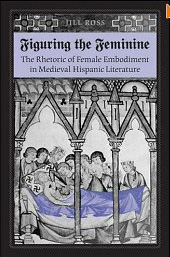 -Figuring the Feminine: The Rhetoric of Female Embodiment in Medieval Hispanic Literature
Figuring the Feminine examines the female body as a means of articulating questions of literary authority and practice within the cultural spheres of the Iberian Peninsula (both Romance and Semitic) as well as in the larger Latinate literary culture. It demonstrates the centrality in medieval literary culture of the gendering of rhetorical and hermeneutical acts involved in the creation of texts and meaning, and the importance of the medieval Iberian textual tradition in this process, a complex multicultural tradition that is often overlooked in medieval literary scholarship. This study adopts an innovative methodology informed by current theories of the body and gender to approach Hispanic literature from a femininst perspective.
Jill Ross offers new readings of medieval Hispanic texts (Latin, Castilian, and Hebrew) including Prudentius’ Peristephanon, Gonzalo de Berceo’s Milagros de Nuestra Señora, Shem Tov of Carrión’s Battle Between the Pen and the Scissors, and several others. She highlights ways in which these texts contribute to the understanding of gender in medieval poetics and foreground questions of literary and cultural import. Figuring the Feminine argues that the bodies of women are crucial to the working out of such questions as the unsettling shift from orality to literacy, textual instability, cultural dissonance, and the resistance to cultural and religious hegemony.
Atsuko Sakaki
 -Recontextualizing Texts: Narrative Performance in Modern Japanese Fiction
Offering the first systematic examination of five modern Japanese fictional narratives, all of them available in English translations, Atsuko Sakaki explores Natsume Soseki’s Kokoro and The Three-Cornered World; Ibuse Masuji’s Black Rain; Mori Ogai’s Wild Geese; and Tanizaki Jun’ichiro’s Quicksand. Her close reading of each text reveals a hitherto unexplored area of communication between narrator and audience, as well as between “implied author” and “implied reader.” By using this approach, the author situates each of these works not in its historical, cultural, or economic contexts but in the situation the text itself produces.
 -Obsessions with the Sino-Japanese Polarity in Japanese Literature
Using close readings of a range of premodern and modern texts, Atsuko Sakaki focuses on the ways in which Japanese writers and readers revised—or in many cases devised—rhetoric to convey “Chineseness” and how this practice contributed to shaping a national Japanese identity.
The volume begins by examining how Japanese travelers in China, and Chinese travelers in Japan, are portrayed in early literary works. An increasing awareness of the diversity of Chinese culture forms a premise for the next chapter, which looks at Japan’s objectification of the Chinese and their works of art from the eighteenth century onward. Chapter 3 examines gender as a factor in the formation and transformation of the Sino-Japanese dyad. Sakaki then continues with an investigation of early modern and modern Japanese representations of intellectuals who were marginalized for their insistence on the value of the classical Chinese canon and literary Chinese. The work concludes with an overview of writing in Chinese by early Meiji writers and the presence of Chinese in the work of modern writer Nakamura Shin’ichiro. A final summary of the book’s major themes makes use of several stories by Tanizaki Jun’ichiro.
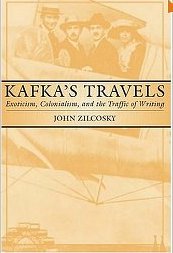 -Kafka’s Travels: Exoticism, Colonialism, and the Traffic of Writing
In 1916, Kafka wrote of The Sugar Baron, a dime-store colonial adventure story, “[it] affects me so deeply that I feel it is about myself, or as if it were the book of rules for my life.” John Zilcosky reveals that this perhaps surprising statement — made by the Prague-bound poet of modern isolation–is part of a network of remarks that exemplify Kafka’s ongoing preoccupation with popular travel writing, exoticism, and colonial fantasy. Taking this biographical peculiarity as a starting point, Kafka’s Travelselegantly re-reads Kafka’s major works (Amerika, The Trial, In the Penal Colony, The Castle) through the lens of fin-de-siècle travel culture. The book offers a lucid, readable introduction into Kafka’s life and work, and sophisticated analysis of Kafka’s major writings in relation to contemporary literary theory.
 -Writing Travel: The Poetics and Politics of the Modern Journey
Interest in travel writing has grown rapidly within the disciplines of postcolonial and cultural studies; however, recent scholarship has failed to place travel writing within the larger literary tradition. Writing Travel assembles a superb collection of essays that demonstrate how travel attempts to reconfigure the world and, in so doing, to become a metaphor for imagination, subjectivity, and representation itself.
Examining a broad range of texts and travellers from across the world, the contributors discuss canonical authors such as Homer, Goethe, and Baudelaire, alongside lesser known writers such as Theodor Herzl, Hans Erich Nossack, and William Gibson. This theoretically rich volume draws connections between travel and narrative, and provides powerful insights into the relationship between travel and the spoken act of storytelling, as well as the more ambivalent act of story writing.
An engaging collection of essays by first-rate scholars, Writing Travel is an illuminating exploration of the history of travel writing, its influence on other literary genres, and the origins of narrative.
– Uncanny Encounters: Literature, Psychoanalysis, and the End of Alterity
Around 1900, when the last blank spaces on their maps were filled, Europeans traveled to far-flung places hoping to find traces of the spectacularly foreign. They discovered instead what Freud called, several years later, the “uncannily” familiar: disturbing reflections of themselves—either actual Europeans or Westernized natives. This experience was most extreme for German travelers, who arrived in the contact zones late, on the heels of other European colonialists, and it resulted not in understanding or tolerance but in an increased propensity for violence and destruction. The quest for an innocent, exotic existence proved to be ruined at its source, mirroring back to the travelers demonic parodies of their own worst aspects. In this strikingly original book, John Zilcosky demonstrates how these popular “uncanny” encounters influenced Freud’s—and the literary modernists’—use of the term, and how these encounters remain at the heart of our cross-cultural anxieties today.